
Garden of the Grooves
Slow Down in Full Bloom This Summer
Rediscovering Grand Bahama’s Garden of the Groves
I am already worried about running late for my 11 a.m. meeting with Marilyn Laing, general manager of Freeport’s Garden of the Groves, as I pull into the parking lot of the fabled garden. I jump out of the car and hurry toward the welcome booth, regretting the quick stop I made along the way.
Moments later, I pause.
At the cobblestone steps beneath the welcome arch, stately olive trees line the path ahead. Sunlight seeps through the leaves, liberally sprinkling the morning light on the tranquil scene. Birds chirp in harmony. A soft breeze responds. The scene insists on stillness.
The path is dotted with forest-green benches, inviting visitors to sit and relax—or at the very least, to accept that the busyness of the outside world has been left behind. There is no longer a need to rush.
At the booth, I learn Laing has already begun her group tour. It is not too late to catch up. I step through the foliage-filled entrance, more slowly now, reminded again that there is no need to hurry.
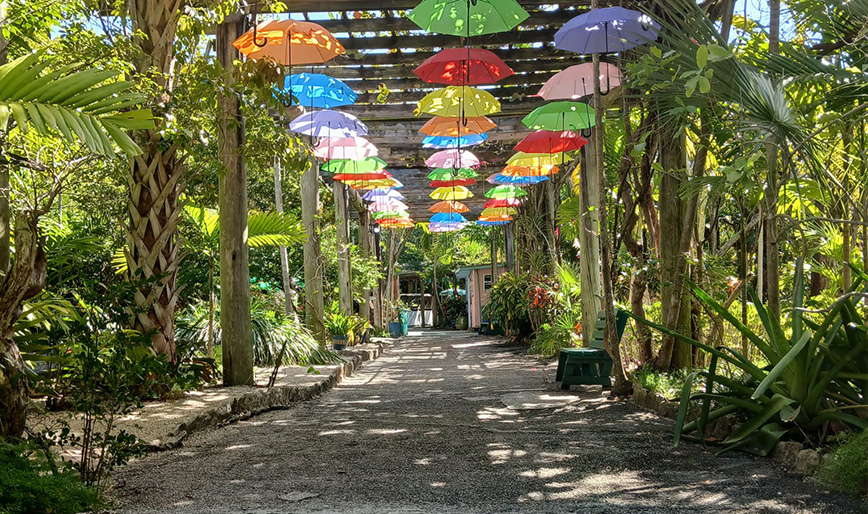
The Garden of the Groves welcomes me with a burst of color. Native and exotic plants bloom in vivid layers, complemented by a canopy of rainbow umbrellas suspended above one of the main paths.
I follow a winding trail across a pond that reappears throughout the 12-acre property past the Garden Café, a lovely shaded space with seating overlooking still water. Within minutes, I catch up to a small group gathered around Laing.
“If you’re as happy as a bird, you’re as happy as can be,” she says, describing the migratory patterns of birds that stop in the garden on their winter journey south.
On this day, Royal, the garden’s cockatoo mascot, is temporarily relocated to escape a recent cold snap. In his absence, red-beaked Muscovy ducks waddle along the paths.
A tribute to Freeport founder Wallace Groves and his wife, Georgette, the Garden opened in 1968. Over the decades, it has become home to a diverse collection of flora and fauna inspired by the Groves’ travels.
The property has changed hands several times, including stewardship by late conservationists John and Erica Gates. Today, it is operated by Bahamas Marine and Land Tours under the Chukka brand, an international destination experience company headquartered in Jamaica. Laing says up to 150 visitors pass through the garden daily.
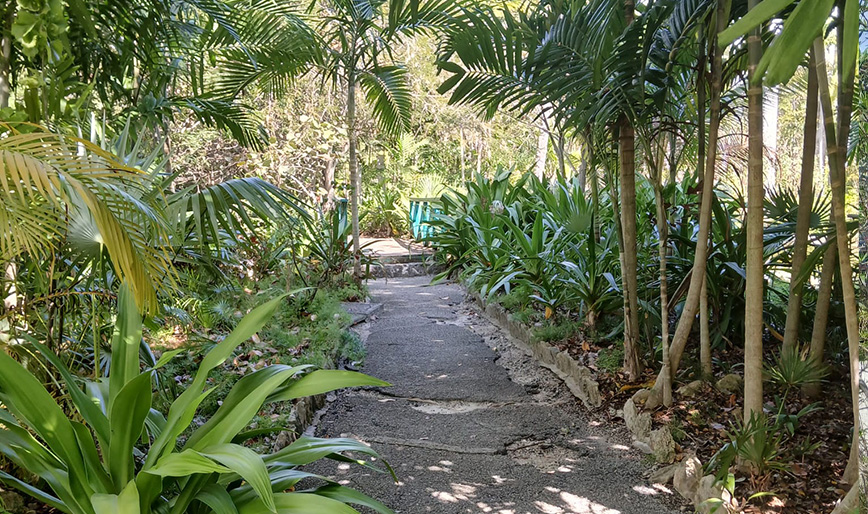
I amble behind the group, listening as curious visitors ask questions. Ferns, bromeliads and palms create a sensory richness that is difficult to move through quickly. Every few steps, I stop to capture the view on my phone.
Soon, the group disappears from sight.
I linger on one of the garden’s small green bridges, angling my camera toward a placid pond speckled with fallen golden leaves. I take a deep breath, the stillness settling in.
When I catch up again, the group has passed the garden’s non-denominational chapel, perched on a small hill, and gathered near the labyrinth.
“The labyrinth is a tribute to the healing process of Grand Bahama after [hurricanes] Frances and Jeanne,” Laing explains, referring to the disastrous storms of 2004.
Closed after the damage, the garden reopened in 2008 through a partnership with the Gates and the Grand Bahama Port Authority. The labyrinth was built by a group of 30 residents led by Barbara Chester.
The garden has endured more than one storm.

I drift away from the tour once more, following a winding path in the opposite direction. It loops and curves, leading me back to familiar sights: a trickling waterfall, a white stone-and-metal gazebo, and Fern Gully—a shaded corridor alive with greenery.
Though I visited often as a child, I see the garden differently now. It has a quiet power—the ability to ease a restless mind, to slow time beneath swaying palms and filtered sunlight.
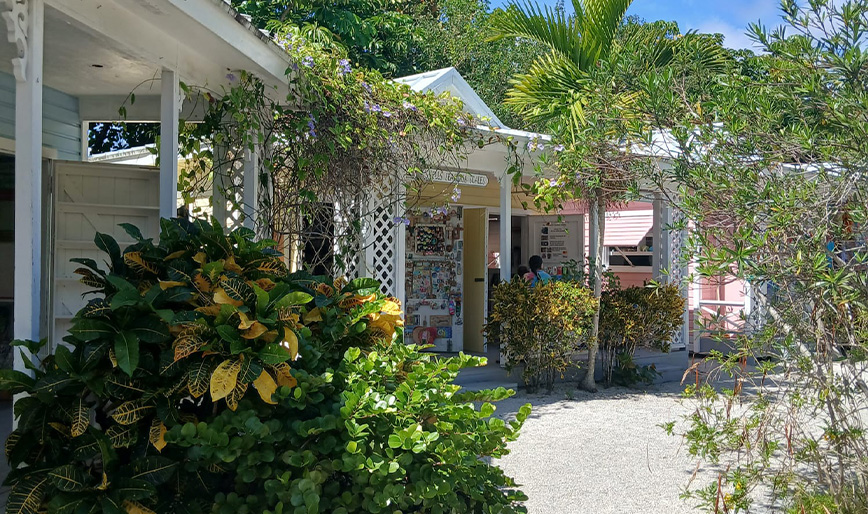
Eventually, I arrive at the craft village, a newer addition. Artisans Gladys Burrows, Bridget Davis and Patrina Johnson welcome me into their cottages, where they sell handmade shell, coconut and straw creations. Each has worked here for more than a decade.
They speak of the garden’s resilience. Its ability not only to endure, but to renew itself—preserving its beauty for generations to come.
I leave their company and continue along the path, the sun warm against my arms.
It feels like a quiet reminder.
To pause. To look up. To take a few minutes—if only a moment—to bask in the beauty of the natural world.
00 Comment
Leave a comment