
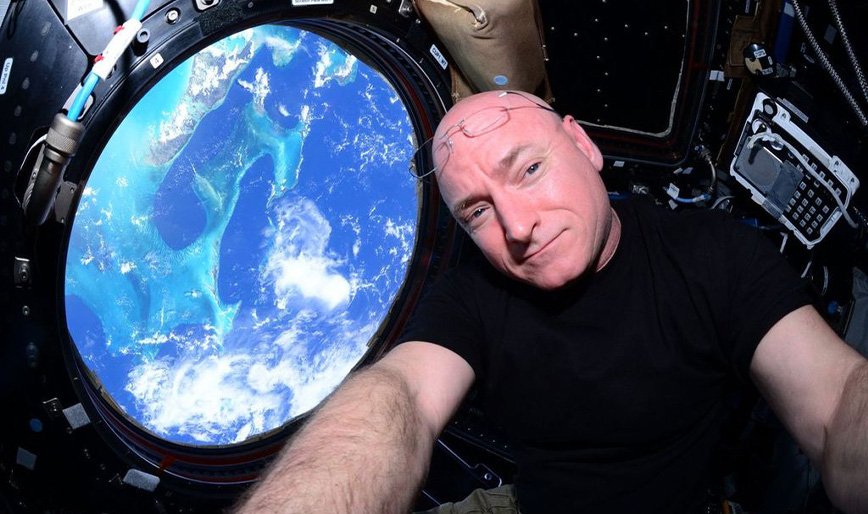
Scott Kelly on The Bahamas, Space, and the Future of Exploration
Summary
When astronaut Scott Kelly looked down at Earth during his year-long mission on the International Space Station, one place stood out more vividly than any other:
The Bahamas.
Its turquoise waters and luminous sandbanks left such a lasting impression that he famously called it “the most beautiful place from space”. Now, as UP magazine launches with a renewed spirit of exploration, that celestial connection finds deeper meaning. In this exclusive interview, Kelly reflects on the striking beauty of The Bahamas from orbit and shares his perspective on the next generation of space pioneers, reminding us just how far Bahamian influence can reach — all the way to the stars.
You once famously said you could see The Bahamas from space and called it “beautiful”. What exactly stood out to you visually about The Bahamas from orbit and what emotions did that view evoke in the moment?
The Bahamas was very blue and very big from space. It's just this massive area of very blue water, basically, that is unmistakable on the planet. There's nothing like it. There are other spots here and there where you see tropical waters from space, but they're generally very, very small areas. You know, the Red Sea, places in the Indian Ocean and certainly the South Pacific, but it seems to me, if you were to add all those together, they still wouldn't be as expansive as the blue waters of The Bahamas. It's unique, I think, on Earth.
You visited The Bahamas once before with your father on a cruise as a child. What part of the country were you most curious to explore again, based on what you saw from orbit?
Actually, The Bahamas was the first foreign country I had ever gone to in my life. After my return from orbit, I visited Nassau and Exuma. I'm a big water person and If I ever go anywhere, I have to touch the water and put my toes in it. So yeah, it was good to go in the water there in The Bahamas.
You’ve seen Earth from a perspective few ever will. How did that global view reshape your understanding of small nations like The Bahamas and their place in the world?
I don't think people realize that when you're flying around the Earth every 90 minutes, you see how interconnected humanity is. It doesn't seem like, you know, Asia is so far away,when you're flying between the United States and Asia in, you know, 45 minutes. So it gives you the sense of this inner connectivity between people, cultures and the environment that is our planet Earth.
People kind of take this for granted, and that is, you know, the accident of your birth. But we're all humans. We're all very much connected with each other, and you can get a sense of that from seeing the Earth from space,
As someone who has spent nearly a full year in space, do you believe certain places on Earth — like The Bahamas — offer a kind of mental or emotional “reset” that astronauts, or even everyday people, need after seeing so much from orbit?
You don't go over any specific place of the Earth every 90 minutes because of the orbit you're in.

When you see someone like Aisha Bowe, with Bahamian heritage, now entering the space field, what does that say about the evolving face of space exploration and who it’s for?
Companies, like Blue Origin and Virgin Galactic, are giving people the opportunity to see space, even if it’s a short period of time.
Whereas my flight lasted 340 days, Aisha’s flight was on the order of minutes, but she still went! She went above the Karman line that defines space, and it's where your lift and drag kind of zero out, and that's considered the boundary of space.
I think it's a great thing, and it's good that we have different sorts of experiences. I'm pretty sure, after talking to Aisha, that she is very capable, and would make a fine NASA astronaut, and I'm sure she could fly in space for 340 days if the opportunity arises.
It's great to have these other ways for people to experience what I have felt is one of the most incredible privileges of my life. I think it's worth it, and it'll get us someday to where we continue to lower the cost, improve the safety and increase access to space for many more people.
What advice would you give to young Bahamians, or young people across the Caribbean, who might be inspired by what you saw from orbit and now by what Aisha is achieving?
I would say find your inspiration. If I can become an astronaut, then it's not impossible for many other people, because I was not a good student.
The people that don't achieve their goals are the people that don't try and the people that give up. But certainly, if you don't try, then you have no chance.
Astronaut Kelly ends his convo with U&A by saying that if he could bring just one item or symbol from The Bahamas with him on a space mission to reflect our spirit and culture, it would be: “A good Bahamian beer”.
00 Comment
Leave a comment